
FHA Property Rules Are Changing.
A report from my seat on NAR’s Federal Financing and Housing Policy Committee, live from New Orleans
Updated November 12, 2026
I’m in my fourth consecutive year on the NAR Federal Financing and Housing Policy Committee, and I treat the seat as a two-way street. I carry what’s happening in Washington back to Shawnee. I also carry what you’re seeing in lending and financing back to the table. Here is what I heard at this week’s meeting during the NAR NXT Conference.
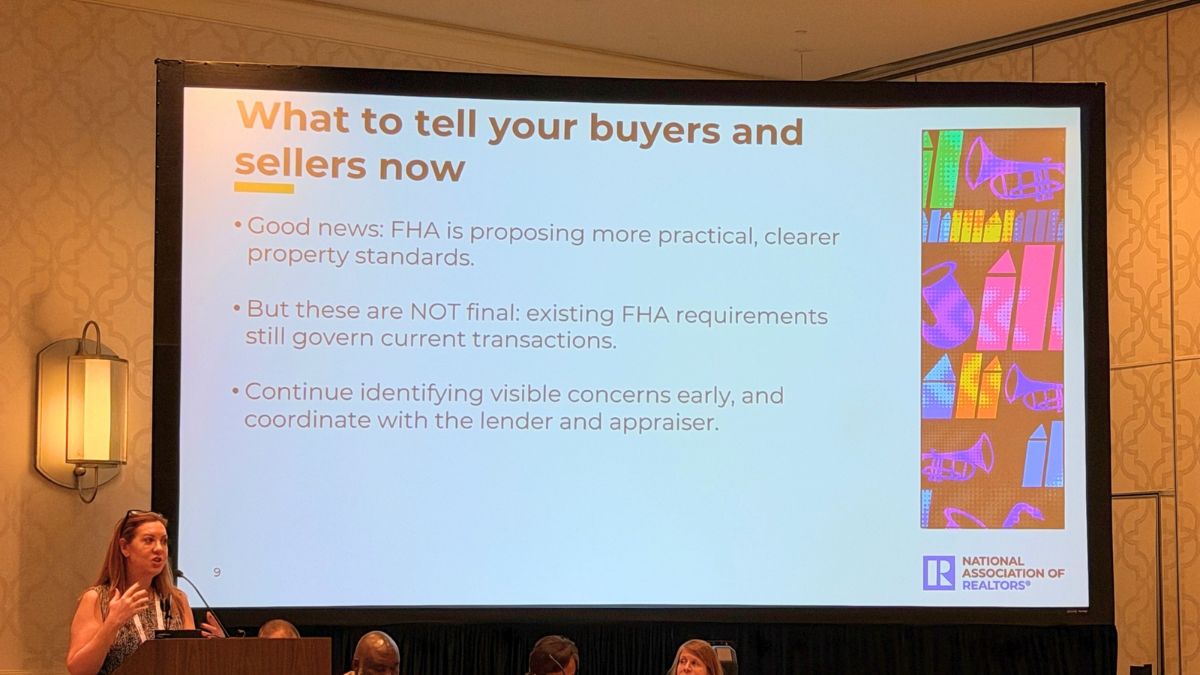
The short version: These changes are proposed, not final. Existing FHA requirements still govern current transactions. Keep spotting visible concerns early, and coordinate with your lender and appraiser.
The FHA minimum property requirements are getting their major overhaul in more than 20 years, and I heard the details in person yesterday in New Orleans.
I’m in my fourth consecutive year on the NAR Federal Financing and Housing Policy Committee, and I treat the seat as a two-way street. I carry what’s happening in Washington back to Shawnee. I also carry what you’re seeing in lending and financing back to the table. Here is what I heard at this week’s meeting during the NAR NXT Conference.
The short version: These changes are proposed, not final. Existing FHA requirements still govern current transactions. Keep spotting visible concerns early, and coordinate with your lender and appraiser.
Why minimum property requirements matter to your transaction
Minimum property requirements, or MPRs, are the condition and safety standards a home has to meet before FHA will insure the loan.
The trouble is how they get enforced. An appraiser walks the house to set a value. Under today’s rules, that same appraiser ends up flagging repairs like an inspector would. A repair flagged late can push back a closing. Some sellers see that coming and turn down FHA offers altogether.
That hits first-time and lower-income buyers hardest, and they are exactly the people FHA loans exist to serve.
What FHA is proposing
FHA released a large proposed update. Here are the highlights I heard:
- Easier to read. Requirements that were scattered around the handbook are pulled together and rewritten.
- Familiar ratings. FHA would use the same condition (C) and quality (Q) ratings you see on conventional appraisals: C1 through C6 and Q1 through Q6. It lines up most closely with Freddie Mac.
- Lead-based paint. A repair would be required only for lead-based or suspected lead-based paint in the home itself. Fences, sheds, and other outbuildings would no longer trigger it.
- Utilities. Local jurisdiction standards would replace a blanket rule.
- Less rigid overall. The scope of required repairs gets refined, and the consumer protections stay.
FHA would still be stricter than conventional financing in places. Even with shared rating terms, it keeps its own framework:
- The draft sets an FHA floor of at least C4 condition and Q5 quality, and defects may need correction before closing.
- FHA-specific requirements remain for certain hazards, property types, and eligibility situations.
- Don’t assume a home a conventional lender will accept automatically qualifies for FHA.
These standards have not been updated in decades, so this is a real modernization.
Where it stands today
It is a proposal, not a final rule. The public comment window closed November 6, the same day as our meeting. NAR filed a letter that praised the effort and asked for two things: training on the new standards for every appraiser on FHA’s panel, not just the new ones, and clearer wording throughout the handbook.
The final version could look different from the proposal. Until it’s final, today’s rules apply to any FHA transaction you have open. If you’re buying or selling with FHA financing, check with me or your lender before you assume anything.
FHA isn’t the only agency having this conversation. In March, NAR testified to a House Veterans’ Affairs subcommittee and urged the VA to align its own property requirements with Fannie Mae and Freddie Mac standards. That matters for veterans and military families here in Central Oklahoma.
The ROAD to Housing Act: good news, slow clock
The 21st Century ROAD to Housing Act became law on July 11, 2026, after final votes in June that were overwhelmingly bipartisan (85 to 5 in the Senate, 358 to 32 in the House). NAR’s presentation called it the biggest housing bill in three decades. Before anyone gets too excited, here’s the reality check we got:
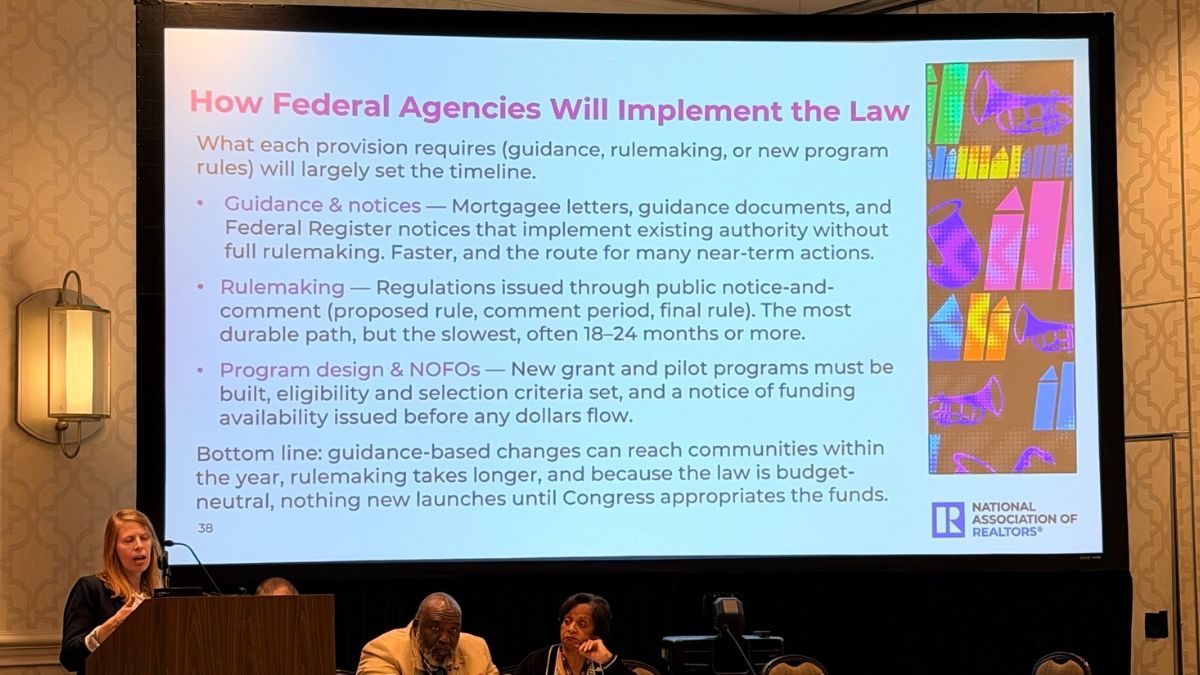
None of them take effect on their own. Agencies have to write rules, issue guidance, and design programs.
New grant programs cannot launch until Congress funds them.
FHA multifamily loan limit increases and new construction guidance for Community Development Block Grants (CDBG) are reportedly close.
often takes 18 to 24 months or more.
put HUD at roughly 30% fewer staff and 15% less funding, with senior people leaving the offices that run CDBG and FHA. That slows everything down.
The federal government is also running on a continuing resolution through December 11. Meanwhile, expect a few quick wins this year and a longer wait on the rest.
NAR keeps implementation resources at road.realtor, including a new outlook for 2027, with key deadlines and a first-quarter action checklist.
What the recent election means for housing
The midterms will bring about 150 new members to Congress. NAR’s advocacy team says its housing priorities don’t change with the results, and its job now is to introduce those members and their staff to the issues. Leadership of the House Financial Services Committee is expected to stay largely in place. NAR staff also expect talk of a second housing package, though nobody knows yet what would be in it.
$57 million in housing counseling is in limbo
This one is important to first-time buyers and homeowners who are struggling with their mortgage.
HUD had tried to narrow how housing counseling money could be used, including shutting out buyers with conventional loans and anyone who wasn’t HUD-assisted. NAR worked with appropriators and got protective language into the House committee report.
Then, days before the September 30 fiscal year end, the administration sent Congress a rescission package timed so Congress would not get its usual 45 days to review it. It included $57 million in counseling funds, and the money would simply expire. People are calling it a “pocket rescission”. Appropriators and the Government Accountability Office (GAO), Congress’s watchdog agency, have said the approach is not allowed, and the matter is in court.
NAR is asking REALTOR® members to tell their representatives why counseling funding matters. If you want to send a note to our delegation, let me know, and I’ll get you talking points.
Two deadlines with a local angle
- Manufactured housing definition. The federal definition no longer requires a permanent chassis. States have one year, until July 2027, to update their own definitions, and states that need a new law get one extra year. A colleague and I are looking into where Oklahoma stands and will share what we find out.
- Public land inventory. Cities and counties that receive CDBG funds must keep a publicly accessible database of publicly owned land before the next grant cycle, around next summer. Contractors who build these databases are limited, so starting early matters. I’ll be asking local administrators whether they’ve begun.
A look at a different market
Our host city had something to teach us. Oji Alexander, CEO of People’s Housing Plus in New Orleans, explained how his group has built more than 270 homes since Hurricane Katrina.
Their tools include a fascinating concept called a community land trust. The buyer purchases the home, and the land is held in trust under a 99-year lease. Resale goes to another income-eligible buyer, with the equity shared roughly 60/40 in the buyer’s favor. His team stacks several subsidy sources, and at 80% of area median income, a buyer of a $200,000 to $250,000 home may see close to $100,000 in help, including up to $55,000 from the city’s down payment program.
Of the more than 1,000 people who applied, nearly half did not qualify on income, and the team is actively working with 12 buyers. He was the first to say a land trust is a tool for specific neighborhoods, not a cure-all.
Shawnee is not New Orleans, but two ideas travel. REALTORS® who understand how to stack down payment assistance can close deals others can’t. And building to a stronger storm standard can lower insurance premiums, which is a real selling point anywhere that knows severe weather.
Quick answers about the FHA proposal
No. They’re only proposed, not final. Existing FHA requirements still govern current transactions.
Yes. FHA keeps its own framework, with a floor of at least C4 condition and Q5 quality, and defects may need correction before closing. The final rules could differ from the proposal.
Not automatically. FHA keeps specific requirements for certain hazards, property types, and eligibility situations.
There is no date yet. The comment window closed on November 6, and FHA now has to review comments and issue a final version.
No. The VA has its own property requirements. NAR has urged the VA to align them with Fannie Mae and Freddie Mac standards, but that’s a separate effort.
Update November 12
What our committee sent to the NAR Executive Committee
Our committee sent seven policy recommendations to NAR’s Executive Committee, which met Sunday, November 8. They approved all seven.
Four deal with large investors buying single-family homes:
- Keep the definition of “large institutional investor” narrow, so small investors and family-owned entities aren’t caught by mistake.
- Give owner-occupants a fair first look at REO and distressed homes, plus better renovation financing.
- Push for better data on who is buying and where.
- Support state and local associations working on this in their own markets.
Three deal with manufactured and modular housing:
- Expand NAR’s policy to cover building, preserving and financing factory-built homes.
- Make the financing rules more consistent across FHA, VA, USDA and conventional loans.
- Support local work on zoning and titling, so these homes can be placed and financed like any other home.
That last group ties to the July 2027 deadline above for states to update their manufactured housing definition. I’m still checking where Oklahoma stands and will share what I find.
Why I travel for this
Yes, I flew to New Orleans for this meeting. And yes, I will travel across the country to sit in rooms with the people who shape how housing finance works.
Here’s why. The rules that decide whether your loan gets approved or your closing gets delayed are written by someone, somewhere. Appraisal standards, loan program requirements, and housing funding are all decided in places like this long before they show up in a Shawnee transaction.
I’d rather be in the room than read about it later. Hearing federal housing officials, NAR policy staff, and REALTORS® from other states in the same meeting gives me context that a headline can’t. I also hear about problems other markets are already working through, many times before they reach ours.
It works the other direction too. When NAR files comments with FHA, it draws on real stories from REALTORS® who work these deals every day. My role is one way Shawnee’s experience gets counted.
The market sets the price. The system behind it, from loan rules to appraisal standards, decides whether a deal can close. I try to understand both, and I keep learning from the best people in the business so my clients get the benefit.
Very few REALTORS® serve at this level, and I take the responsibility seriously. The more local agents who get involved, the better the rules get for everyone.
What I need from you
This committee works best when it hears from the people living the transaction. If you’re a buyer, seller, lender, appraiser, title professional, or local official and you’ve watched a loan get stuck, tell me where. Which requirements trip up deals here? What are your clients running into with financing? I’ll take it to the people who can make change.
Reach me at steve@soldonshawnee.com or 405-585-6580.
Sources and further reading
- HUD: single family policy drafts and feedback (comment deadline was November 6)
- HUD: eight-page summary of proposed FHA MPR changes
- NAR: HUD opens review of minimum property requirements for FHA mortgages (June 2026)
- NAR: statement on FHA decision to remove red tape and promote homeownership (June 26, 2026)
- HUD: FHA INFO 2026-22 (September 22, 2026)
- NAR: ROAD to Housing Act implementation resources
Slide content in this post comes from NAR’s presentations at the Federal Financing and Housing Policy Committee meeting, November 6, 2026.